
What We Reinforce
Commitment 5: We Align Systems with What We Say We Value

Start with the Ordinary Moments That Shape Everything
It often begins in a room that feels ordinary, maybe it’s a budget conversation where difficult tradeoffs are being considered, a program review shaped by enrollment pressure, or a hiring discussion where multiple strong candidates are being evaluated.
These moments rarely feel dramatic. We move through them as part of the work we do every day. And yet, over time, I have come to see that these are some of the most formative moments in an institution. This is not because of the decisions alone, but because of what those decisions reveal. They tell us what gets protected, what gets prioritized, and what gets measured.
In one recent meeting, I was working with a team on considering how to continue to build out our mentoring plan for students. At this point in the semester, everyone was focused on getting their grades in and feeling ready for a break. And, the challenges around our goal of assigning a faculty mentor to every student are real. This was a group of faculty, so we all know well the true time demands that faculty members have. When we came together to think about how to approach this and do it well and what we could learn from what we’ve already tired, I think we were all feeling a bit overwhelmed and maybe at an impasse.
But, coming together to build a vision and dream about the future provided all of us with much needed energy. Rather than focusing on how hard it would be to make a change, we started by naming what the students and employers are looking for at this point in time. We asked ourselves, could we create an enhanced way of supporting students that centers Lipscomb’s mission, harnesses faculty’s knowledge and skill, and provides our students with an extra level of support and sense of belonging?
Something shifted in the room. The weight of end-of-the-semester exhaustion lifted for a moment, replaced by something lighter and energizing, curiosity and shared purpose. We were no longer just problem-solving at that point, we were dreaming together of a possible future for our students. That shift did not remove the constraints that surrounded our planning. But it changed how we engaged them. In that moment, it became clear to me once again:
The structure of the conversation itself was forming how we would lead.
In earlier essays, we have explored how leaders abide in mission, design for belonging, hold rigor and care together, and model the transformation they seek.
Each of these commitments shapes culture in visible ways. But what I’ve been learning is that over time, another layer begins to matter just as much:
The systems that surround those commitments.
Long before a policy is created, the syllabus is read or a class is taught, institutions are already forming people. They do so through what I have come to think of as a hidden curriculum, which is embedded not in content, but in structure.
People learn from:
what is rewarded
what is measured
what is funded
and what is celebrated
These patterns tell a story about what matters. And over time, they shape behavior in ways that are often more powerful than anything we say. As I’ve seen in my own work, environments marked by trust and hospitality invite engagement, risk-taking, and growth. Environments shaped by fear or fragmentation diminish those same things, even when intentions are good. What I’ve come to understand is that every system teaches.
When Mission and Structure Drift Apart
Most institutions do not abandon their mission in a single moment. Instead, they drift. That drift rarely begins in mission statements. It begins in systems that slowly shift toward other priorities. We see it in subtle ways. For example, growth metrics expand enrollment but thin formation, evaluation systems prioritize output over mentoring, and definitions of innovation emphasize efficiency more than transformation.
None of these decisions are made with the intention of undermining mission. They are often responses to real pressures. But over time, they accumulate. And what we see is that students learn what matters by what is assessed, faculty learn what is valued by what is rewarded, and leaders learn what is possible by what is funded.In seasons of pressure, this drift can accelerate. Urgency begins to shape structure, and structure begins to shape culture. This fact raises a harder question than most strategy conversations allow:
Do our systems reinforce what we say we value, or quietly undermine it?
Aligning Systems with What We Say We Value
This leads to the fifth commitment in the Abiding Leadership Model:
We align systems with what we say we value.
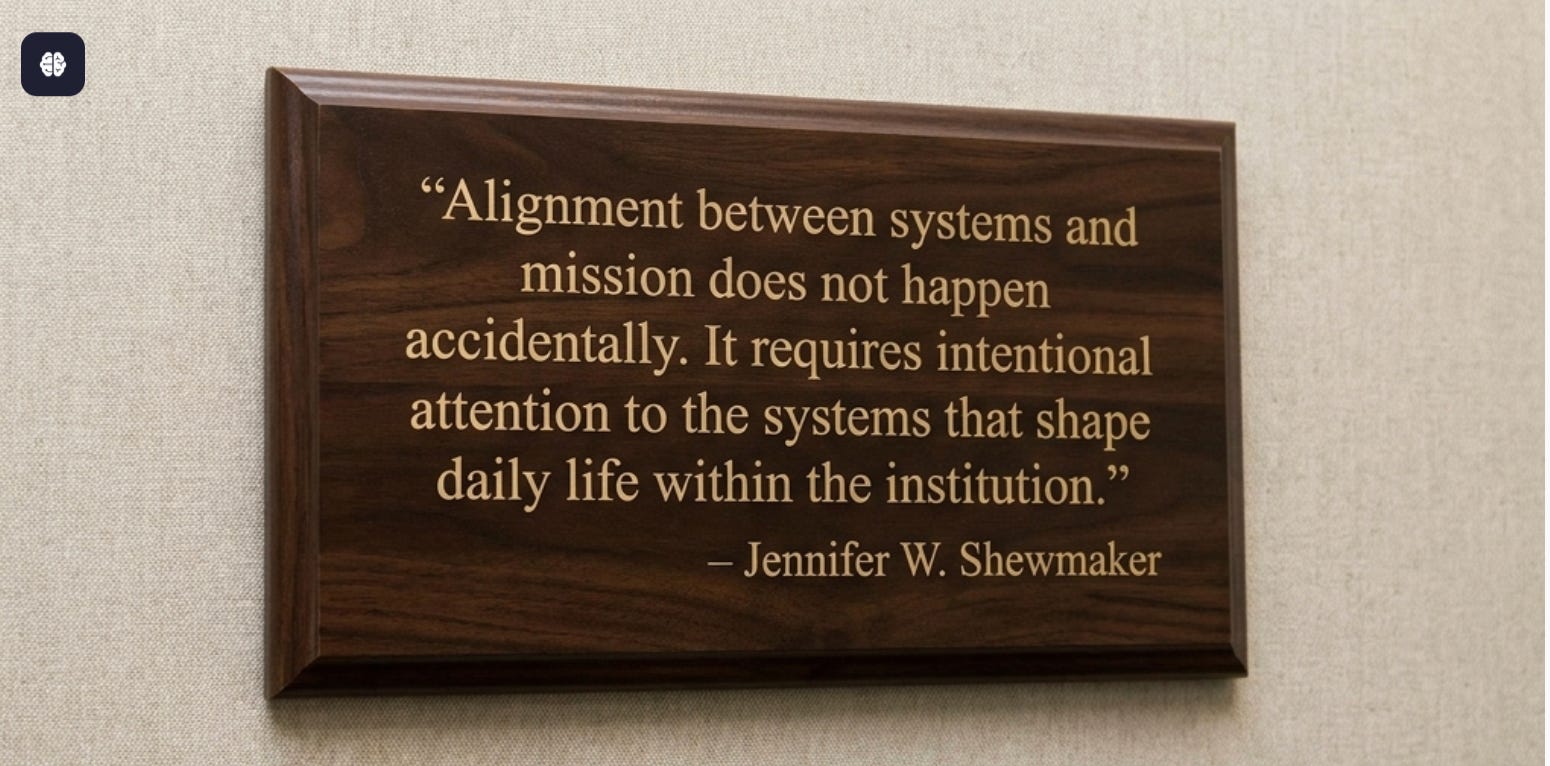
This is vital to consider, because culture fractures when structures contradict mission, but it grows when there is alignment between the two. If we say that formation matters, then our systems must support formation. If we say that belonging matters, then our structures must create space for participation. If we say that growth matters, then our evaluation processes must reflect that belief. Alignment does not happen accidentally. It requires intentional attention to the systems that shape daily life within the institution.
I think of alignment then, as not a one-time achievement, but a continual tension to be held with intention. It requires a posture of openness and seeking of connection between mission, systems, and behavior that shapes every decision.
From Reaction to Stewardship
One of the most significant shifts a leader can make is moving from a posture of reaction to a posture of stewardship.Reaction asks: What do we need to fix right now? Stewardship asks: What are we responsible to protect, cultivate, and redesign?
This shift reframes any constraints that the team may be facing, inviting leaders to ground decisions in shared reality, to name what is outside of their control, and then to focus deeply on where they still have agency.
In my own work, this has meant centering a set of orienting questions in my own mind before meetings or decisions:
What is mission-critical and must be protected?
Where are we experiencing misalignment?
What decisions position us for faithful, long-term impact?
These questions do not simplify the work, in fact, sometimes they complicate it by forcing you us to consider long term over short term gains. What they do is help ensure that our decisions are shaped by purpose rather than pressure.
I think it’s important to acknowledge that this work is not without cost, and for most of us, there are often systems set up and decision points that we are not in charge of. To examine our systems honestly is to risk discovering that we have been a part of the drift, or that there are challenges at our institution that we must face head on. This requires humility, to name where our structures have quietly contradicted our stated values. It also requires courage to slow the work down so that we realign when we notice drift, or to call out drift to our supervisors and ask for intentionality around alignment.
Practicing Alignment in Daily Leadership
Alignment becomes visible in the everyday structures of an institution, in how we evaluate performance, how we allocate resources, and how we define success. When we take time to examine these systems honestly, we begin to see where there is alignment and where there is not. Sometimes the work is about reinforcing what is already working. At other times, it requires redesign.
For example, it may mean rethinking how mentoring of students, faculty, or staff is recognized in evaluation processes. It may mean building time and space for discernment into decision-making structures. Or, it may mean aligning budgets more closely with mission priorities.These are not simply operational adjustments. They are formative decisions, because over time, systems scale what leaders value.
From Alignment to Courage
Each commitment in the Abiding Leadership Model builds on the one before it. When leaders abide in mission, design for belonging, hold rigor and care together, and model transformation, culture begins to shift. When systems are aligned with those commitments, that culture becomes sustainable. People begin to act with greater clarity. They take thoughtful risks that reflect shared purpose. They engage difficult work with a sense of trust. Courage becomes more than an individual act, it becomes a shared capacity within the community.
Moving Forward
If this commitment invites us to align systems with what we value, then the ongoing work is learning to examine those systems honestly. It is easy to assume that our structures reflect our mission or to just ignore our structures. It is harder to test that assumption, and to put the time and energy into evaluating our systems for mission alignment. Abiding leadership calls us to return to that work again and again. It asks us to notice where alignment is strong, to name where it is not, and to make the adjustments required to close the gap.
A Practice for This Week
As you lead this week, consider one system that shapes the work of your team. It might be a meeting structure, an evaluation process, or a way that decisions are made. Take time to ask:
What does this system actually reinforce?
And then consider:
How might it more fully reflect what we say we value?
Even small shifts can begin to change the culture over time.
Three Questions to Carry With You
At your institution, where is there a gap between what we say matters and what our systems reinforce?
What is one structure I have the ability to influence right now?
What would it look like to approach that structure as an act of stewardship rather than reaction? Would that shift in perspective change the way you think about the challenges of changing the structure?
An Invitation
Structures will form people whether we intend them to or not. The question is whether we will design them with the same intentionality we bring to strategy, programs, and vision. As you lead this week, consider what your systems are teaching.This is vital, because we know that institutions are not transformed by ideas alone. Systems play an important role. Transformation can come when the structures of the institution reflect the mission it claims to serve.
This is the work of aligning what we say with what we build. And when we do, we create institutions where mission is not just spoken, but is lived out every day.