
Designing Institutions That Abide
Building Cultures of Flourishing in an Age of Acceleration

Not long ago, I found myself sitting around a leadership table discussing the future of higher education at a conference about Christian scholarship. Over the course of the conference, artificial intelligence had entered nearly every conversation. We talked about emerging technologies, changing student expectations, workforce trends, demographic shifts, and the growing pressure to adapt. Eventually someone asked the question that has become almost instinctive for organizational leaders:
“How do we keep up?”
It is an understandable question., and, in many ways, it is the question institutions have always asked during seasons of disruption. But as I listened, I found myself wondering whether it was the wrong place to begin, because “keeping up” assumes that speed is our greatest challenge, and frankly, I’m no longer convinced that it is. After spending the past year writing about abiding leadership in the age of AI, I understand that the greater challenge is something deeper.
It is remembering who we are while the world around us changes.
Leaders matter, and iInstitutions do too. While leaders influence culture, institutions sustain it over time. They shape the environments where people learn, work, worship, serve, and discover their calling. They influence the questions we ask, the behaviors we reward, the relationships we cultivate, and the unmade future we imagine and bring forth together. What I’ve come to understand is that institutions are never neutral. Instead, I think of them as formative, meaning that every institution is quietly shaping who people become.
That realization has changed the way I think about leadership, and how we support institutions as they adapt to change and disruption. I’ve been convicted that one of my primary responsibilities as a leader is to ask what kind of people our institution is helping to form as we navigate change.That, I believe, is the invitation before us now.
Throughout this series I have argued that abiding is a deliberate commitment to remain deeply rooted while continuing to grow, and that is true for both leaders and for institutions. An abiding institution is not one that resists change, but neither is it one that pursues every new opportunity. Instead, I’ve seen that an abiding institution is one that remains anchored in its mission while cultivating the wisdom, adaptability, and relationships necessary to flourish amid change.
Here’s what I mean by that: an abiding institution remembers who it is before deciding what it should do, develops people as intentionally as it develops programs, and understands that every policy, process, reward system, and conversation is shaping a culture that is, in turn, shaping people.
That is why institutions are never merely administrative structures. I’ve come to understand them as communities of formation.
Three Commitments of an Abiding Institution
Over the past several years, I’ve found myself returning to the same question in strategic planning conversations, faculty development, and institutional change efforts:
What helps an institution remain faithful to its mission while continuing to grow?
In my experience, there are a handful of commitments that shape how an institution approaches change. They influence not only the decisions leaders make, but the kind of culture those decisions create. Reflecting on organizations that seem best equipped to flourish in seasons of disruption, three commitments consistently stand out.
1. Abiding Institutions Are Designed for Discernment
A great temptation during periods of rapid change is to confuse speed with wisdom.
Over the past two years, as we’ve been heavily engaged in integrating AI into our work, I’ve noticed that artificial intelligence has only intensified that temptation toward speed. New technologies emerge almost daily, bringing with them both extraordinary possibilities and anxieties. I think leaders understandably feel pressure to respond quickly. I know that I’ve felt that pressure at times.
Yet I’ve also come to understand that some of the most important decisions an institution makes cannot be rushed. Discernment requires something really different from speed. It asks us to slow down long enough to ask deeper questions. For example, not simply, Can we do this? But: Should we? Does it align with who we are? Will it help us become more fully the institution we aspire to be?
In my own experience, discernment rarely happens in isolation. Some of my best thinking has emerged in conversation with trusted colleagues willing to wrestle with difficult questions together. In fact, I’ve increasingly found that small groups, thoughtful dialogue, and even asynchronous conversations supported by technology create space for wisdom that hurried meetings often cannot. Creating time to gather, to think, to hash out ideas and ask each other questions has led to some of our team’s greatest breakthroughs.
Abiding institutions intentionally create those spaces. They understand that discernment is cultivated over time.
Culture Is Never Neutral
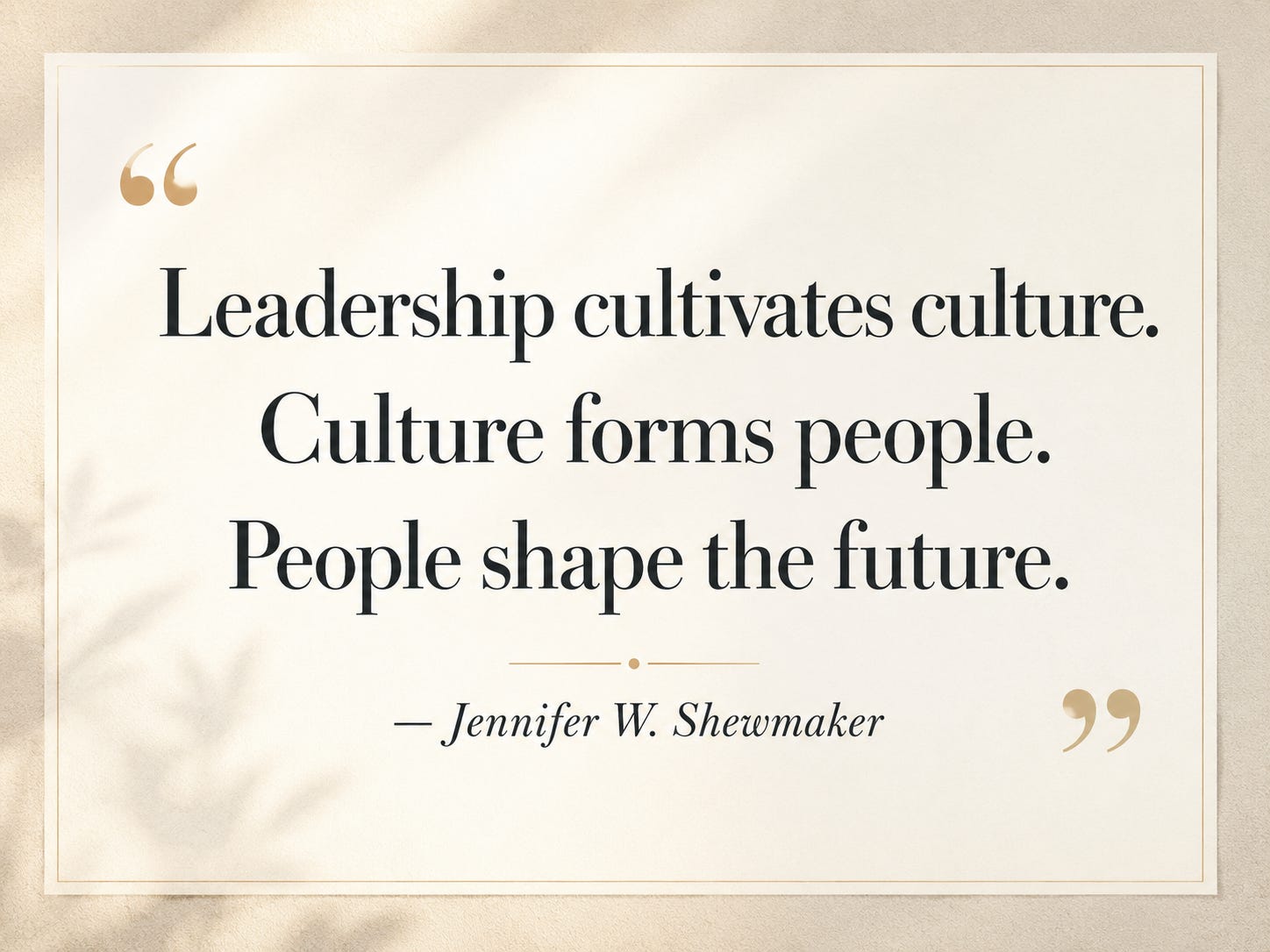
The more time I spend in leadership, the more convinced I become that culture is one of the most powerful forces shaping an institution. We often think of culture as something intangible that simply develops over time. But culture is continually being formed through the decisions we make, the questions we ask, the behaviors we reward, and the stories we tell. In that sense, culture is not accidental, but is designed, sometimes intentionally, and sometimes unintentionally. But that design always has consequences.
If institutions are communities of formation, then culture becomes one of the primary ways that formation occurs. Long before a strategic plan is written or a mission statement is revised, people are learning what truly matters by watching how leaders respond to uncertainty, how colleagues treat one another, and what the institution consistently celebrates.
That is why discernment matters so deeply. Discernment is not simply about making better decisions, it is about shaping a culture that helps people become more fully who they are called to be.
Only then can we begin asking a second question: What are we intentionally forming?
2. Abiding Institutions Are Designed to Form People
A significant shift in my own thinking has been realizing that institutions are always forming people, whether they intend to or not. For years, I thought primarily about programs, initiatives, strategic plans, and organizational outcomes. Those things matter, of course. But over time I’ve come to see that initiatives are also shaping habits, policies are communicating values, and meetings either cultivate trust or diminish it. Believe me, now that I’m aware of this, I think about it all the time. Every time I plan for a faculty meeting, this is on my mind, and when I prepare for my one-on-one meetings, I’m thinking about it.
I know that institutions are formative. For me as a leader, the real question is: What kind of people are we helping to become? That question has become one of the guiding questions of my own leadership.
When I talk about formation, I’m not referring to a particular curriculum or program. Formation is the gradual shaping of our character, imagination, relationships, habits, and sense of purpose. It is the slow work of becoming. Formation unfolds over time through relationships, experiences, reflection, and practice.
I’ve come to believe that this is a primary responsibility of an institution, particularly educational institutions. I was just talking about this with a group of academic leaders today. I am convinced that we do not simply prepare people to perform jobs or master content. At our best as an institution of higher education, we help people become wise, discerning, courageous, compassionate, and purpose-filled human beings who are equipped to contribute meaningfully to the world around them, to be agents of positive change, to love and serve our neighbors.
This has become especially clear to me through our work integrating artificial intelligence across the university. What began as conversations about technology quickly became conversations about teaching, trust, vocation, ethics, and what it means to prepare students for purposeful lives. AI was the catalyst, but the deeper work has always been about formation.
That realization has changed the questions I ask as a leader. Instead of asking only whether a new initiative will increase enrollment, improve efficiency, or strengthen our competitive position, I find myself asking questions focused on formation, such as: How will this shape the people entrusted to our care? What kind of culture will it create? How will it influence the way our students, faculty, and staff understand their purpose and their responsibility to others?
As we consider institutions as a whole, it’s important to remember that programs educate, culture forms and mission gives direction. When those three things are aligned, institutions become places where people are not only prepared for successful careers, but formed for lives of purpose and service, where they find their unique strengths and passions and understand how those things can come together to meet the needs of the world in their unique calling. .
The longer I serve in higher education, the more convinced I become that this is our deepest work. Institutions that intentionally cultivate discernment and intentionally form people inevitably begin asking an even larger question. Formation for what? To what end?
Those questions move us beyond the walls of our organizations and toward the communities we are called to serve. They invite us to consider not only the flourishing of our institutions, but the flourishing of our neighbors. That is where the third commitment begins.
As a long time educator, I’ve learned that formation is never an end in itself, and that’s imperative for us to both understand and to help our students do so. We are not formed simply for our own success, fulfillment, or professional advancement. We are formed so that our gifts, character, and calling can be placed in service of something larger than ourselves.
That is one of the reasons I continue to believe so deeply in the mission of higher education. At its best, education is not simply about transferring knowledge or preparing students for careers. It is about helping people discover how their unique strengths, passions, and convictions can be woven together in ways that contribute to the flourishing of their communities.
The same is true of institutions. An institution that intentionally cultivates discernment and formation eventually begins asking a larger question: How does our own flourishing contribute to the flourishing of others?
3. Abiding Institutions Are Designed for the Common Good
I’ve shared before that I think part of institutional design is being aware of how institutional decisions ripple outward into communities, industries, and civic life. At Lipscomb, one of the components of our vision is that we will be ambitious in our service to others. That means that everything we do needs to be evaluated and shaped in light of how it enhances our ability to love and serve our neighbors.
At an alumni event this year, one of our alumni shared a beautiful sentiment with me that I can’t stop thinking about. He was talking about the role that Lipscomb has played in the Nashville community for 135 years. He noted how the University has always served our community, since the founding of the institution. He said, “We want people to see us as the place that takes care of them, and has done that for a long time.” It reminded me of the story I’ve heard often at Lipscomb, that during the cholera outbreak of 1873, while many wealthy citizens fled Nashville, David Lipscomb stayed. Even in the midst of his own health challenges, he stayed, and he cared for the sick. That action on Lipscomb’s part exemplified his conviction that the work we do at the institution is for the common good. Long before he founded an institution, he embodied the kind of institution he hoped to build.
A Call to Leaders
As I think back to that leadership conversation where someone asked, “How do we keep up?” I realize that today I would answer differently than I might have even just a few weeks ago. That’s because as I’ve been struggling with these ideas, I’ve realized that perhaps the question isn’t whether we can keep up. Perhaps the better question is whether we can remain rooted while we grow.
I think we need to be asking ourselves as leaders:
How do we cultivate institutions that remember who they are before deciding what they should do?
How do we design cultures that help people become wiser, more courageous, more compassionate, and more committed to the flourishing of others?
Because in the end, the unmade future will be shaped by the institutions that never lose sight of why they exist. That means institutions that discern wisely, that intentionally form people, and that understand their vocation is to contribute to the common good. Those are the institutions that abide. And I believe they are the institutions that will help all of us flourish in the unmade future we are creating together.