
Aligning Structure with Formation
Designing the Missional Institution

If institutions are moral ecosystems, how do our structures form the people within them?
Meetings as Formation
It often begins in a room that feels ordinary. Maybe it’s a budget meeting where priorities and mission are not considered alongside needed reductions, or a program review shaped more by enrollment pressure than mission alignment, or a hiring decision where the most compelling candidate is not the one most aligned with mission, but the one most likely to stabilize a program.
These moments rarely feel dramatic, we tend to move through them as just a part of our day. And yet, those moments can be deeply formative. What if formation were not something we hoped would emerge from the everyday decisions we make, but the primary thought shaping those decisions? The truth is, formation is not sustained by aspiration, but by everyday alignment between mission and action. I’ve witnessed this tension firsthand in my own leadership work.
Recently, I facilitated a meeting with a team that I serve as we were called to make some difficult decisions. The fatigue in the room showed on every face. We had faced similar work before, and it would have been easy to move quickly to action or to complaining about having to do the work in the first place. Instead, we began differently. We named the emotional weight and clarified what we could not control and what was in our control. And then we asked: If we were building this today in the current circumstances, what would we design?
I rolled a giant whiteboard into the room and we named what we couldn’t control so we would not spend time bemoaning those issues. Then we named what we could control, and seeing that list grow longer and longer was empowering! We then named what we had to prioritize and protect for long-term sustainability and mission, and what our next steps needed to be. Doing this exercise together as a team helped us put aside issues outside of our control, identify what we had power to engage with, and prioritize the things that had to be protected as we considered next steps. With the common understanding we built through this activity, the team members were then able to go forward and focus on their own areas to move the work forward.
The shift that this shared thinking provided did not remove the constraint or pressure, but it reframed it. We moved from a focus on reaction to a focus on stewardship. And in that moment, it became clear: the structure of the meeting itself was forming how we would lead.
The Hidden Curriculum
Long before a syllabus is read or a class is taught, institutions are already forming people. They do so through a quiet but powerful curriculum that is embedded in structure. This is shown through things like what gets rewarded, what gets protected, what gets measured, and who gets elevated. These are not only operational questions, but formative ones.
In my own work, I have seen how deeply the environment shapes learning. When we create spaces marked by hospitality and trust, people are more willing to engage, to take risks, and to grow. When fear or fragmentation takes hold, engagement diminishes, even when intentions are noble. Every incentive system, calendar priority, and metric chosen tells a story about what matters. Every structure teaches.
Even the way we structure our conversations becomes formative. I’ve found that when there is hard work to be done, and wicked problems to be addressed, it works best to set simple but intentional norms for our team: we will be honest but not cynical, we will focus on agency, we will protect what matters most, and we will think beyond the easy and immediate answers toward redesign that provides sustainable answers. These are not just facilitation strategies, but formative structures that shape whether leaders and their teams default to fear or move toward courage in times of pressure.
When Structure and Mission Drift Apart
Most institutions do not abandon their mission outright, rather, they slowly drift away from it. That drift rarely begins in vision statements that are changed, but instead begins in systems shifting away from the original mission of the institution and toward something else.
We see it in subtle but significant ways:
Growth metrics that expand enrollment but thin formation
Faculty evaluation models that privilege output over mentoring or teaching
Definitions of innovation that prioritize efficiency over transformation
AI adoption that accelerates capability without cultivating wisdom
These are not failures of intention, but failures of alignment. Over time, they shape the people within the system. Students learn what matters by what we measure. Faculty learn what is valued by what is rewarded. Leaders learn what is possible by what is funded.
Drift often accelerates in moments of constraint or pressure. When pressure increases, institutions can default to speed, to short-term metrics, to decisions that feel necessary but are disconnected from mission. Without intentional structure, urgency becomes the hidden curriculum.
Which raises a harder question than most strategy sessions allow:
How does this structure prepare learners for purposeful lives? How does it advance our institutional mission?
Three Shifts Toward Formation-Centered Design
If formation is truly central, then our structures must reflect it, not occasionally, but consistently. Here are three places to begin.
1. Incentivize Formation, Not Just Production
What we reward, we reproduce. If mentoring is invisible in promotion criteria, it will slowly disappear. If community impact is unrecognized, it will become peripheral. If ethical and interdisciplinary inquiry is optional, it will remain rare.
On the other hand, when we name and reward these practices, they begin to shape the institution itself. Formation becomes not an aspiration, but an outcome.
2. Build Time for Discernment into Governance
Formation requires space. But most institutional systems these days often focus on speed. We move quickly, toward adoption, expansion, and implementation, often without creating space for discernment. This is especially true in moments of technological acceleration.
But what if our structures reflected a different value? What if we were able to build:
Slower, more intentional processes for major technological decisions
Ethical reflection embedded within strategic planning
Faculty cohorts designed for integrating AI, mission, and pedagogy
If we could do this, we would see that discernment is not inefficiency. It is formation at work.
3. Align Resources with Missional Priorities
Every budget tells a story, not just about sustainability, but about belief.
If we say formation matters, but invest primarily in branding, if we say faculty are central, but underinvest in their development, if we adopt AI tools based on cost and convenience rather than their capacity to deepen learning, then our structures are telling a different story than our mission.
A budget is not just a financial document, it is a missional one. Now, that’s not to say that, when focused on mission, budgets can never be reduced and programs or initiatives ended. In today’s rapidly changing and complex times, these are decisions that have to be made. My encouragement is to make them with an eye toward the mission and identity of the institution. Which programs or initiatives are most aligned with the formation we are seeking? How do we lean into supporting and prioritizing those?
In my own work focused around resource allocation, I have encouraged the team I serve to approach times of constraint or pressure as an act of discernment. We begin with a set of questions that helps us align around mission, stewardship, and sustainability:
What is mission-critical and must be protected?
Where are we experiencing structural inefficiencies or misalignment?
What decisions position us for faithful and sustainable impact in the next 3–5 years?
This approach requires naming both what we will protect and what we are willing to reconsider. It provides the team the opportunity to be proactive and focused on strategic alignment with mission. The questions above have become our compass, pointing toward the north star of the institutional mission. But getting in the habit of asking them required a fundamental shift in how we understood our role as leaders, a shift from managing scarcity to stewarding mission. This is not an easy mindset to stay in, and is a work in progress for most leaders who take this approach. If you find yourself struggling to stay here, that’s okay.
A Focus on Stewardship
One of the most formative shifts leaders can make is moving from a mindset of reactivity to pressures to a mindset of stewardship. This is a crucial shift, because reactivity asks: What must we lose? While stewardship asks: What are we responsible to protect, cultivate, and redesign?
In practice, this means grounding decisions in shared reality, naming what is outside our control, and then focusing deeply on where we still have agency. It means making differentiated, mission-aligned choices in times of pressure or constraint. What I’ve found as a key idea here is that stewardship does not eliminate constraint, but it transforms how we respond to it.
A Simple Diagnostic for Leadership Teams
This stewardship mindset requires practical tools for honest assessment. We can begin by considering that if structures form people, then we as leaders must learn to evaluate the structures within our own institutions honestly.
Here are four questions I suggest bringing into leadership conversations:
Where does our structure reward courage?
Where does it reward speed?
Where does it cultivate wisdom?
Where does it unintentionally incentivize fear?
These questions matter because fear quietly reshapes behavior, limits risk-taking, narrows imagination, and constrains learning.
But environments marked by trust and hospitality create the conditions where people are willing to engage deeply and grow meaningfully. Structures do the same work at scale. They either expand the space for courage or they shrink it.
When the team I serve faces challenging work, we have begun pairing reflective questions with structured criteria. I ask that every proposal, whether it be focused on creating a new program or initiative or ending or redesigning an existing one, be evaluated for financial impact, mission alignment, student impact, long-term sustainability, and future positioning. This ensures that our decisions are not merely efficient, but formative and focused on mission and our long-term goals.
The Courage to Align
Designing for formation is not primarily a technical challenge, but a missional one.
Because formation-centered structures often resist the dominant logic of urgency, efficiency, and short-term gain. They ask us to slow down, to question what we have normalized, and sometimes to choose differently. And that requires courage.
But if we believe that institutions are called not simply to produce outcomes, but to form people for lives of purpose, wisdom, and service, then alignment is not optional. It is essential. Because the question that all leaders need to be considering right now is not simply whether our institutions will change. It is whether our structures will form people of courage, wisdom, and purpose or quietly train them to reactively respond to outside pressures.
A Question to Carry Forward
As you think about these ideas in regard to your own institution, I’ll leave you with this:
Where is there a gap between what you say matters and what your structures actually reward?
That gap is where formation is either strengthened or quietly undone. As leaders, we must consider whether we will design structures with formation in mind.
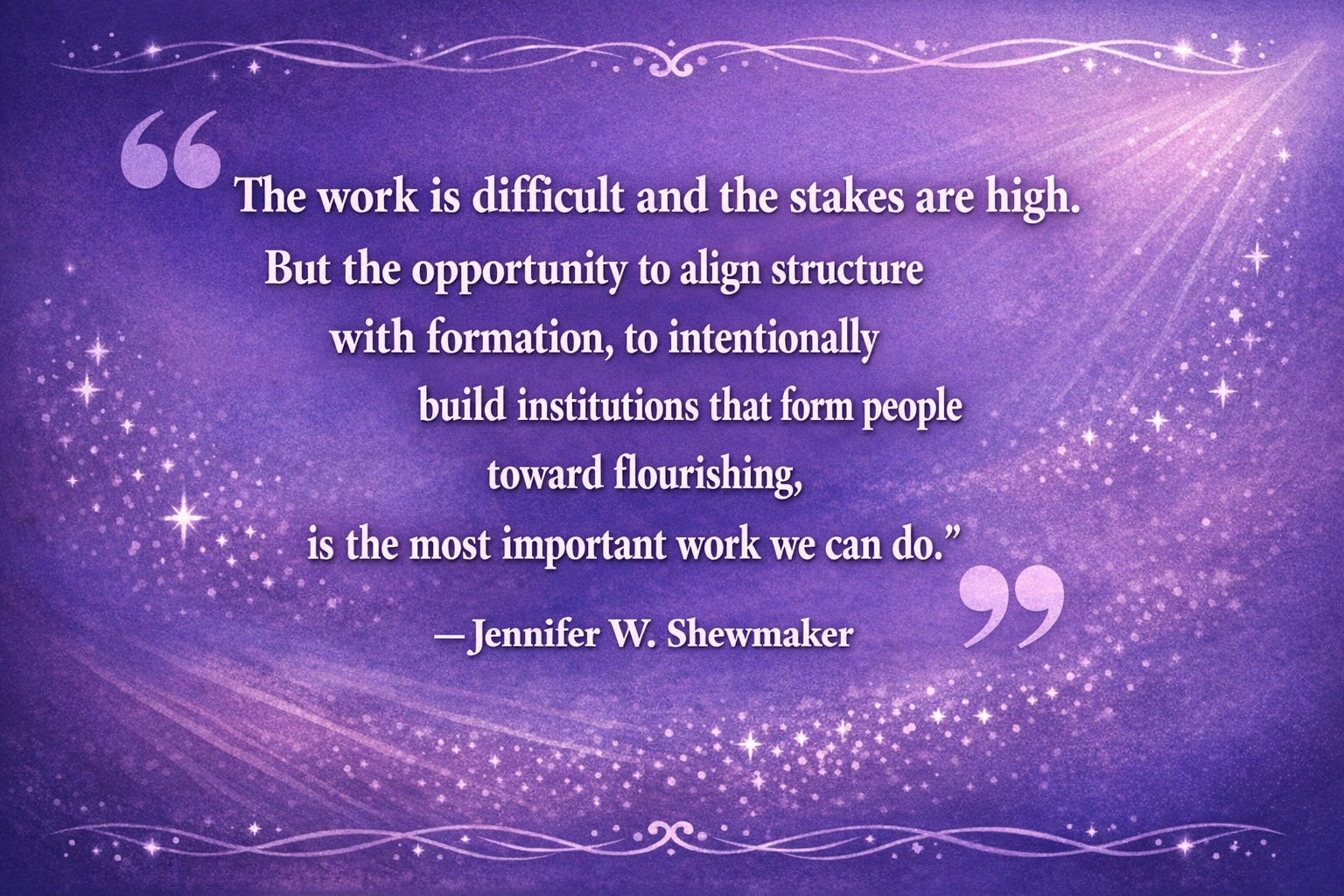
Here is what I have been learning: structures will form people whether we intend them to or not. The question is not whether formation will happen, but whether we will design for it with the same intentionality we bring to budgets, programs, and strategic plans. The work is difficult and the stakes are high. But the opportunity to align structure with formation, to intentionally build institutions that form people toward flourishing, is the most important work we can do.